Who's really collaborating?

(From the interpersonal dynamics of listening... working towards understanding the collaboration structures that shape what interactions are even likely or possible in food systems work)
In the UK food systems space—at least from the civil society perspective—it is often said that it's a small world, that everyone knows everyone, or that certain organisations always show up. Like Sustain; the Soil Association; Landworkers' Alliance; Nature Friendly Farming Network; the Food Foundation; Pasture for Life; Eating Better; the Food, Farming and Countryside Commission (FFCC).
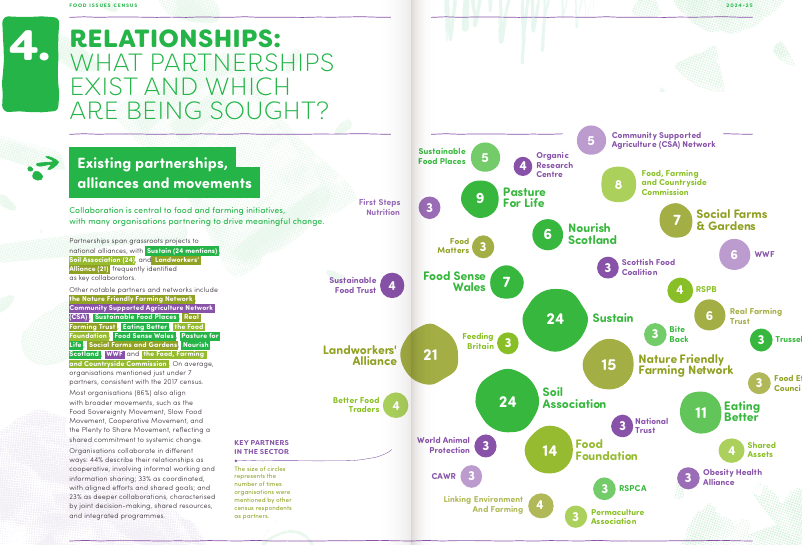
We might guess these usual suspects regularly show up because they are better funded, more established, have a national/regional/cross-cutting rather than local/niche remit, and/or lots of different projects that bring them into contact with diverse others.
But if we're really trying to get clear on who is working with whom, and how resources and ideas and narratives flow around—it's actually quite difficult! At least, as a relative outsider. There are a number of factors but one I'm drawing attention to here is the messy reality of cross-organisation connections. Well, attempting to draw attention to that, by sharing a snapshot of current thoughts.
I'm new to social network analysis and am getting to grips with the method by looking at some of the data available from Agri-Food for Net Zero Network+ (AFNN+). Namely, public information about projects that AFNN+ has funded.
Even looking at this data on a per-funded-project basis you encounter challenges with how to classify organisations and understand the reality of collaborations. Let's take one example: a project assessing the impacts of a scheme giving 120 households weekly £11 vouchers for fruit and veg purchases at Cardiff farmers markets.
8 organisations are mentioned in the project information, linked to 8 people. (Interestingly that is not a 1:1 mapping. Some people are linked to multiple orgs, and some orgs are represented by multiple people.)
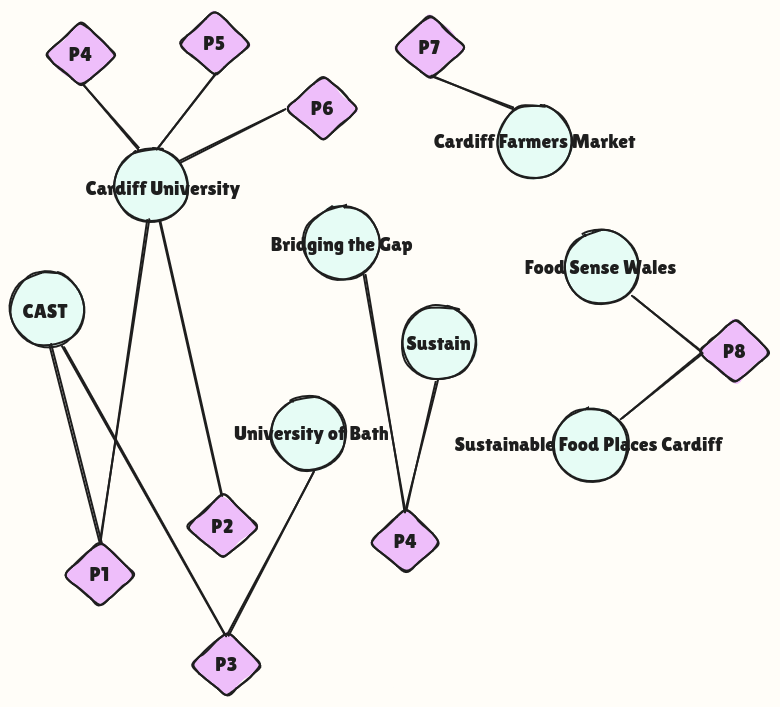
Sustain and Bridging the Gap are represented by one person. I'm curious and wonder what is Bridging the Gap? Apparently it's a "programme" (according to one of the involved orgs Food Sense Wales), "led by Sustain, Growing Communities and Alexandra Rose Charity with nation partners Food Sense Wales, Nourish NI and Nourish Scotland". So, is this person actually working for Sustain and one of their projects is Bridging the Gap? Is Bridging the Gap being named because it's a programme that has a bit of its own identity, separate to Sustain?
And: What counts as leadership? How meaningfully involved are "partners"? What extent of power and participation do they have—in design or just delivery? Who holds the funds?
Sustain is named on the info pages for two other AFNN+-funded projects. One evaluating the introduction of vegan/vegetarian low emission menus one day a week in Newcastle primary schools. The other focuses on exploring how to plant and conserve more wild crops on farms, for "agricultural purposes" (not "just" environmental goals).
And, small world! Sustainable Food Places is also named as an org involved in that latter project. But this time it's not Sustainable Food Places Cardiff but Sustainable Food Places in general.
I go to learn more about how Sustainable Food Places is structured, and learn that it isn't a single entity with a branch in Cardiff. It's a "network" and "partnership programme". And a partnership led by none other than... oh, hello again, Sustain, Food Sense Wales, and Nourish Scotland (among others). And searching for Sustainable Food Places Cardiff leads me to the Cardiff member of the Sustainable Food Places network/programme: Food Cardiff. And Food Cardiff "sits within"... you guessed it, Food Sense Wales(!)
Which all leads me away from wanting to think in terms of organisations, but more in terms of the people. In the Cardiff-based AFNN+ project, yes, Bridging the Gap and Sustainable Food Places Cardiff are name checked. But they are associated with the same two people respectively representing Sustain and Food Sense Wales. A sensible conclusion might be that really, the people are mainly associated with/working for Sustain and Food Sense Wales. The other orgs are just name-checked—perhaps because they want the "brands" to gain prominence. And/or it's just not the orgs that matter, but the people.
When we look at the Bridging the Gap and Sustainable Food Places programmes/initiatives, this is the overlap in lead orgs:
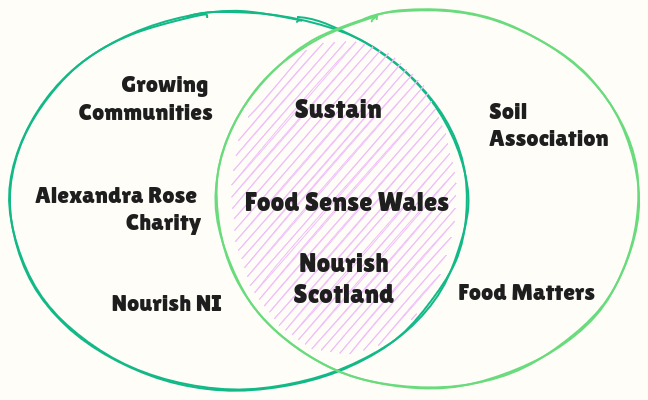
So I'm wondering: is a lot of this just an exercise in branding? For which audience(s)? And underneath it all, is it really just a set of a few productive and well connected individuals winning funds and making projects happen?
And network analysis terms for the little network considered above, Sustain and Food Sense Wales would be more central than the others, but then the question is, in what way are we measuring and thinking about the importance of being more or less central in a network...
This is not a polished post but really capturing where I am in trying to work out the basics of social network analysis research design, i.e. specifying whether the nodes (actors) in a network representation of AFNN+-funded projects are going to be people or organisations (or, more complicatedly, both). And thinking through what is lost/gained with either lens.
What criteria are important for me in thinking about organisations? And so how does that lead me to characterise an initiative like Bridging the Gap: as a separate entity or essentially part of Sustain? Based on who holds the funding, or who does most of the work? Is there a binary choice: that I need more information about how collaborations are really working in practice... or I make a decision based on what the publicly available data show? I think a lot of social network analysis proceeds with the latter but then makes sense of its findings using contextual (qualitative) information.
Organisations seem important symbolically/ideologically as well as materially. They represent and work to realise different food systems futures, rooted in different visions and values. They direct resources and seek to influence policy. So as well as proceeding with network analysis, I need to get more into this conceptual stuff (organisational theory?)
At the same time, organisations are made up of people. It's the people that do things, that actively realise and maintain the relationships that organisations appear to have. And, if the secondary data I'm using are thinking more per-person than per-org, it might be more coherent for me to follow suit.
Argh! Lots of questions.
That's where I am for today. Any helpful thoughts or recommendations welcome!